

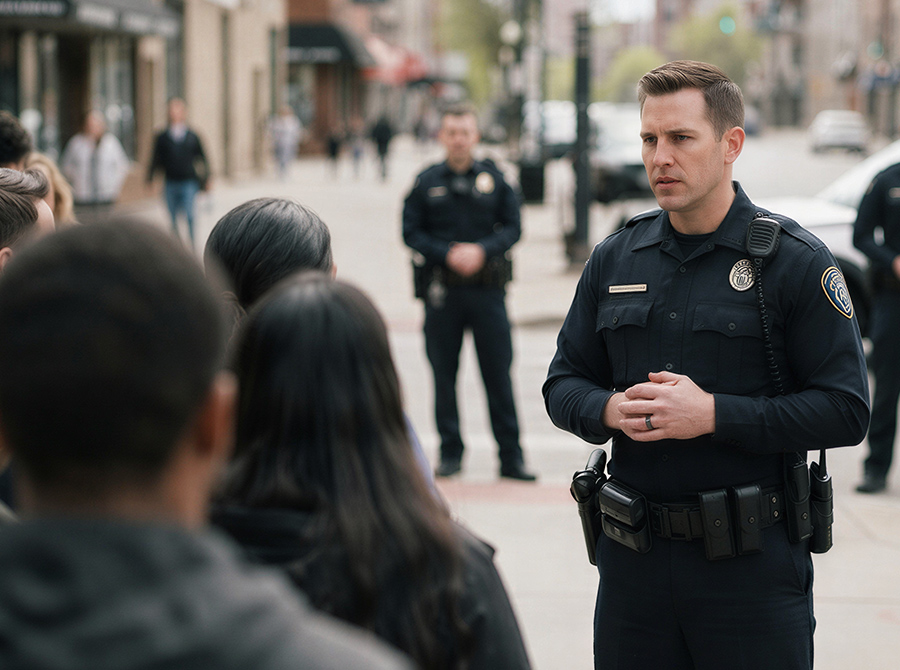
Law enforcement officers are called upon to de-escalate not just individuals, but also groups of people. Crowd De-escalation for Law Enforcement Officers requires a basic understanding of crowd psychology, which can help police de-escalate a crowd.
The modern study of crowd psychology dates to the late 1800s, when social unrest across Western Europe drew attention to how people behave differently in groups. French psychologist Gustave Le Bon coined the term “crowd theory” and became its most influential early voice. He believed crowds strip people of reason and logic. As a result, crowds make them suggestible and prone to unruly behavior. That idea shaped many assumptions about crowds that persist today, including some that can actively work against officers trying to manage one safely. However, modern research tells a different, and far more useful, story.
What is a Crowd?
Before getting into what changed, it helps to define terms. A crowd simply refers to a gathering of individuals. However, not all crowds are the same kind of gathering. Some form intentionally around a shared purpose, like an audience gathered to hear a speaker or a group organized for a protest. Others form casually and without any real connection between the people involved. For example, a crowd waiting at a bus stop or filling a shopping mall is casual. Intentional crowds tend to have a much higher degree of cohesion and shared identity than casual ones. That distinction matters for law enforcement crowd management and de-escalation.
Understanding Group Identity in Crowd De-escalation
The current understanding of crowd behavior, grounded in social identity theory, doesn’t treat crowds as a group that has lost its sense of reason and logic. Instead, it recognizes something more familiar: belonging to a group becomes part of how a person sees themselves. Importantly, this isn’t unique to crowds. It’s the same psychological mechanism behind identifying with a family, a workplace, or a faith community.
What changes in an intentional crowd setting is that this group identity can temporarily become more important than a person’s individual identity, a process called deindividuation. Two things tend to drive it. First, people feel less personally accountable for their actions when surrounded by others. Second, their attention shifts away from their own individual values and standards. Their focus moves toward whatever the group around them is doing.
There is also a kind of illusion of safety that comes with being part of a crowd. This brings a sense of being harder to single out, which can embolden behavior a person might not otherwise engage in alone. In that state, group norms become the default. If the people around someone are calm, that calm tends to spread. However, if the norm shifts toward disorder, that spreads too.
Not All Crowds Behave the Same Way
Understanding this process helps explain why crowds gathered for the same general purpose can behave in completely different ways. Three patterns show up most often:
- Prosocial crowds — the most common type for gatherings organized around a social or political cause. Deindividuation here can actually reinforce positive behavior, since people are influenced by observing the calm, constructive actions of those around them.
- Violent crowds — develop when a norm of violence takes hold, whether that norm was established beforehand or triggered by a single catalyst in the moment, such as someone damaging property or acting aggressively. Because behavior spreads quickly once that norm sets in, a crowd that starts out peaceful can shift quickly if the right catalyst appears.
- Apathetic crowds — where the presence of a group actually produces less action, not more.
It’s also worth remembering that even a crowd gathered around one shared purpose is rarely made up of people who all think alike. Political and social crowds in particular tend to include different subgroups with varying values, goals, and intentions. Therefore, this is part of why understanding crowd psychology matters more than simply sizing up a crowd as a single, uniform entity.
Why Being in a Crowd Can Make People Do Less
It’s counterintuitive, but larger groups often make individuals less likely to help someone in need. This isn’t because people don’t care, but because everyone assumes someone else will step in. Ambiguous situations make this worse. If it’s unclear whether something is actually an emergency, people look to others for cues. Furthermore, if no one else is reacting, that becomes the signal that everything must be fine. Everyone is waiting on everyone else.
This dynamic was observed in the case of Kitty Genovese, a young woman assaulted and killed in New York in the mid-20th century in front of numerous witnesses, none of whom intervened. While some details of that case have since been questioned, it remains one of the most widely studied illustrations of how a crowd’s presence can paradoxically reduce, rather than increase, the likelihood that any one person acts.
Why Crowd Psychology Matters to Law Enforcement Officers
One of the more important, and more actionable, insights from crowd psychology experts is this: treating an entire crowd as dangerous because a violent subgroup exists within it can backfire. Most people in a crowd do not want violence and understand that it creates problems for everyone. Painting the whole group as a threat risks pushing that peaceful majority toward siding with the minority causing trouble, rather than against them.
Understanding crowd psychology isn’t about predicting exactly how any individual will behave. Instead, it’s about recognizing that the group’s prevailing norm, not some loss of individual reasoning, is usually driving what’s happening. That distinction changes how a situation should be interpreted and approached.
Studying crowd psychology can help law enforcement officers successfully manage and de-escalate crowds. Police Legal Sciences, Inc. (PLS) provides Iowa law enforcement officers with online de-escalation training examining crowd psychology and management, situational assessment, verbal and physical de-escalation techniques, emotional regulation, and officer mental health. Subscribers complete the full lessons, including scored knowledge checks and continuing education credit. Learn more about PLS Legal Update here.