

Leadership in a 911 Communications Center presents its own unique challenges and demands, requiring more than just management skills. Leadership and management aren’t the same thing, though the terms get used interchangeably in emergency communications. Management is structural: protocols, staffing, performance metrics. It’s essential to keep the center running. Leadership is the ability to influence and support people toward a shared goal. Unlike a management title, it isn’t handed out on an org chart.
That distinction matters more in a 911 center than in most workplaces. Dispatchers are often called the first, first responders. They calm a caller and gather information long before anyone arrives on scene. In addition, leadership author Simon Sinek has argued that the strongest leaders aren’t the ones with the most authority, but the ones who create a sense of purpose and trust around them.
The dispatcher who calmly takes charge during a multi-agency call, or the coworker who mentors a struggling new hire, is leading just as much as anyone with “supervisor” in their title.
So, what does that kind of leadership actually look like, and where does it come from?
Traits That Define Strong Leadership
Leadership in a 911 Communications Center starts with a set of traits. Ten of them show up consistently in dispatchers and supervisors who lead well:
Integrity · Self-Awareness · Vision · Communication · Empathy · Resilience · Collaboration · Influence · Courage · Gratitude
None of them require a formal title. A senior dispatcher who mentors a new hire is drawing on the same traits as a shift supervisor managing a crisis.
Traits are the raw material, but style is how a leader actually applies them on shift. This is where a lot of well-intentioned leaders get it wrong, not because they lack the right traits, but because they apply the wrong approach to the moment.
Six leadership styles show up regularly in dispatch:
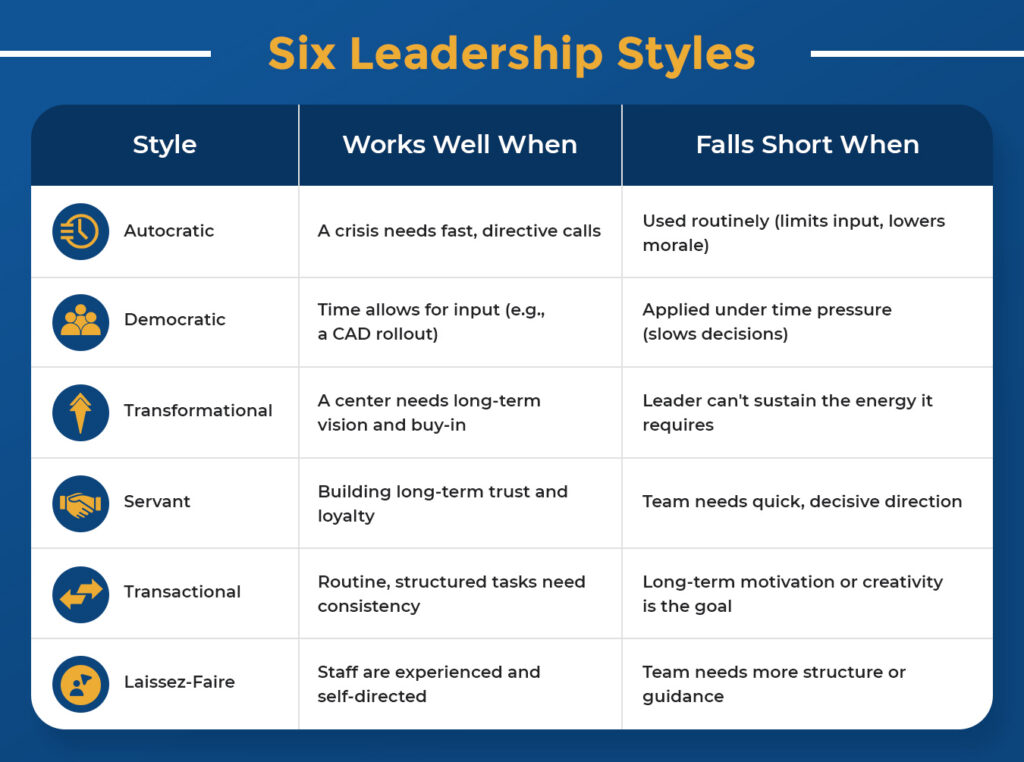
No single style is right in every situation. What matters is matching the style to the moment: urgency, team experience, and the task at hand all shape which approach works. This adaptive matching is sometimes called situational leadership. Moreover, it’s a skill in itself, separate from any one style.
Team Dynamics and Psychological Safety
Traits and style describe what one person brings to the room. But a communications center doesn’t run on one person. It runs on a team. Furthermore, even the best individual leader can’t compensate for a team that doesn’t function well together.
“Nobody cares what you know until they know you care.” General (Ret.) Paul E. Funk II
Leadership in a 911 Communications Center must extend beyond individual performance to building trust across the team.
Team dynamics are the roles, relationships, and communication patterns that develop among coworkers. Common breakdowns include role confusion, poor communication, lack of trust, and unresolved conflict.
At the center of healthy team dynamics is psychological safety, defined by Harvard Business School professor Amy Edmondson as the shared belief that it’s safe to ask questions, admit mistakes, or raise concerns without fear of embarrassment or punishment.
Psychological safety is harder to build in a 911 center than in most workplaces:
- Constant high-stress call volume leaves little room for reflection
- Shift work and fatigue wear down patience and emotional bandwidth
- A “tough it out” culture discourages people from asking for help
- Dispatchers are heard by the public but rarely seen, which breeds a sense of invisibility
- Supervisors without training in emotional intelligence can unintentionally reinforce silence
Where psychological safety exists, teams recover faster from bad calls, catch more near-misses, and treat mistakes as opportunities to learn rather than hide them.
Building Stronger Leadership in a 911 Communications Center
Put all of this together, and it’s tempting to think leadership development means a big initiative: a new training program, a policy rewrite, a formal mentorship structure. Sometimes those things help. But most of what separates a communications center with strong leadership from one without it isn’t a program at all. It’s a string of small, ordinary choices, repeated often enough that they become the culture. Nobody remembers the day their center rolled out a new leadership policy. However, people do remember the supervisor who owned a mistake instead of burying it, or the coworker who checked in after a bad call without being asked. That’s the behavior that actually builds trust, and it looks a little different depending on where you sit.
Day to day, on the floor, it looks like:
- Owning a mistake in front of the team instead of letting it get buried in a report
- Staying composed and clear when a call goes sideways, rather than letting stress dictate tone
- Mentoring a new dispatcher through their first hard call, without being asked to
- Following through on small commitments, like sending a resource or checking back in, so trust builds in the routine, not just the crisis
For supervisors and directors, it looks like:
- Matching leadership style to the situation: directive during a crisis, collaborative when rolling out a workflow change
- Gathering frontline input before changing a protocol that affects the floor, not just after
- Responding to mistakes with questions before consequences
- Creating regular, low-stakes moments for people to speak up, like a check-in question, a debrief, or a shift huddle, so psychological safety isn’t only tested during a crisis
The common thread: leadership shows up in ordinary moments more often than dramatic ones, and it’s built through repetition, not a single gesture.
Leadership Training for 911 Communications Centers
This overview is based on a recent Dispatch Pro lesson, The Foundations of Leadership Part 1, which covers the leadership versus management distinction, the ten traits and six styles above, and the team dynamics and psychological safety concepts that shape a communications center. It also includes self-assessments and exercises dispatchers can apply on shift.
Dispatch Pro’s monthly lessons cover the full range of what the job requires: effective interviewing techniques, risk management, real call analysis, dispatcher mental health, and, as this lesson shows, the leadership skills that hold a team together under pressure. Request a free trial to see how Dispatch Pro can support your center’s training.